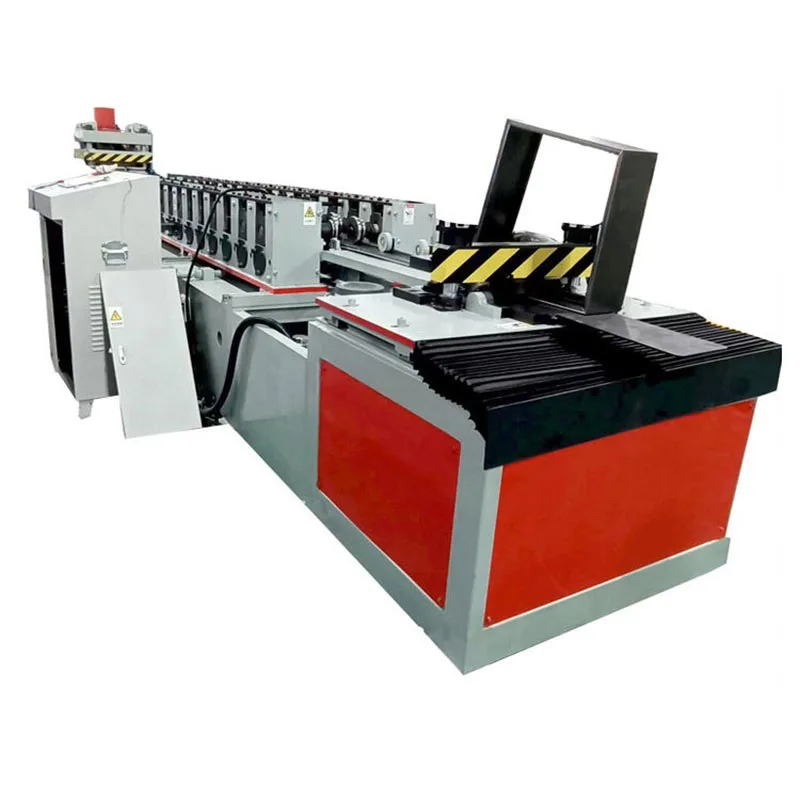
What is a Pipe Roll Forming Machine?
A Pipe Roll Forming Machine is a cornerstone of modern metal processing. It transforms continuous coils of sheet metal into consistent, high-quality pipes or tubes. This is a cold-forming process. The metal strip passes through a series of rolling stations, or stands. The metal strip is progressively shaped by each set of rolls. It is transformed into a closed profile, which is then welded into a strong, seamless tube. This method is valued for its high efficiency, precision, and superior material utilization.
Types of Machines
The core technology adapts to create various profiles. Key machine types include:
The Welded Square Tube Forming Machine:This machine turns flat metal strips into precise square or rectangular tubes. The process starts with rolls progressively curving the strip's edges upwards. Then, another set of rolls forms this curved shape into a profile with sharp, defined corners. The tube is then welded along the seam and finished, delivering the dimensional consistency and structural integrity vital for construction, storage, and furniture frameworks.
Standard Tube Roll Forming Machine: This is the classic machine for manufacturing round pipes. It is highly versatile. It can handle a wide range of diameters and metal thicknesses. The forming process is smooth and continuous. It results in a perfectly round tube with a uniform wall thickness. These round pipes serve in many common uses. They are ideal for moving fluids, providing structural support, and functioning as components in various mechanical assemblies.
Metal Window & Door Frame Cold Roll Forming Machine: This machine produces the specific profiles needed for window and door frames. Its design is more specialized. It creates complex cross-sections with grooves and lips for glass panels, seals, and hardware. The cold roll forming process guarantees that every meter of the frame has the exact same shape. This allows for easy assembly and perfect fit. It is vital for mass production in the building materials industry.
Product Advantages
These Pipe Roll Forming Machines clearly outperform traditional manufacturing methods. They offer distinct advantages in speed, precision, and cost-effectiveness.
They operate at high speeds. This enables mass production and meets large-volume orders efficiently. The process is highly automated. It reduces labor costs and minimizes human error.
Precision is a fundamental advantage.These machines guarantee consistent shapes and tight tolerances in every batch. This directly enables perfect part interchangeability, simplifying assembly and boosting overall efficiency.
Material waste is very low. The process uses coiled strip metal directly. It creates little to no scrap compared to methods like machining. This leads to direct cost savings.
The cold-forming process also strengthens the metal. This is called work hardening. It improves the final product's strength and durability without heat treatment.
Finally, these systems are remarkably flexible. With quick roll changes, a single machine can produce multiple profiles and sizes. This reduces downtime and increases overall workshop versatility.
Application Scenarios
The use of pipe roll forming machines is widespread across many industries.
In construction, they produce structural components. These include square tubes for building frames, scaffolding, and roof trusses. Round tubes are used for handrails and electrical conduits.
The automotive industry relies on them for parts like exhaust pipes, roll cages, and structural frame members.
Furniture manufacturing uses these machines to create frames for chairs, tables, and shelving units. The consistent quality is perfect for modern furniture design.
They are also essential in agriculture. They make irrigation pipes, components for greenhouses, and parts for farming equipment.
Furthermore, these Pipe Roll Forming Machines produce everyday items. These include lighting fixtures, display racks, and various household appliances. Their ability to create strong, lightweight, and custom-shaped tubes makes them indispensable in modern manufacturing.